


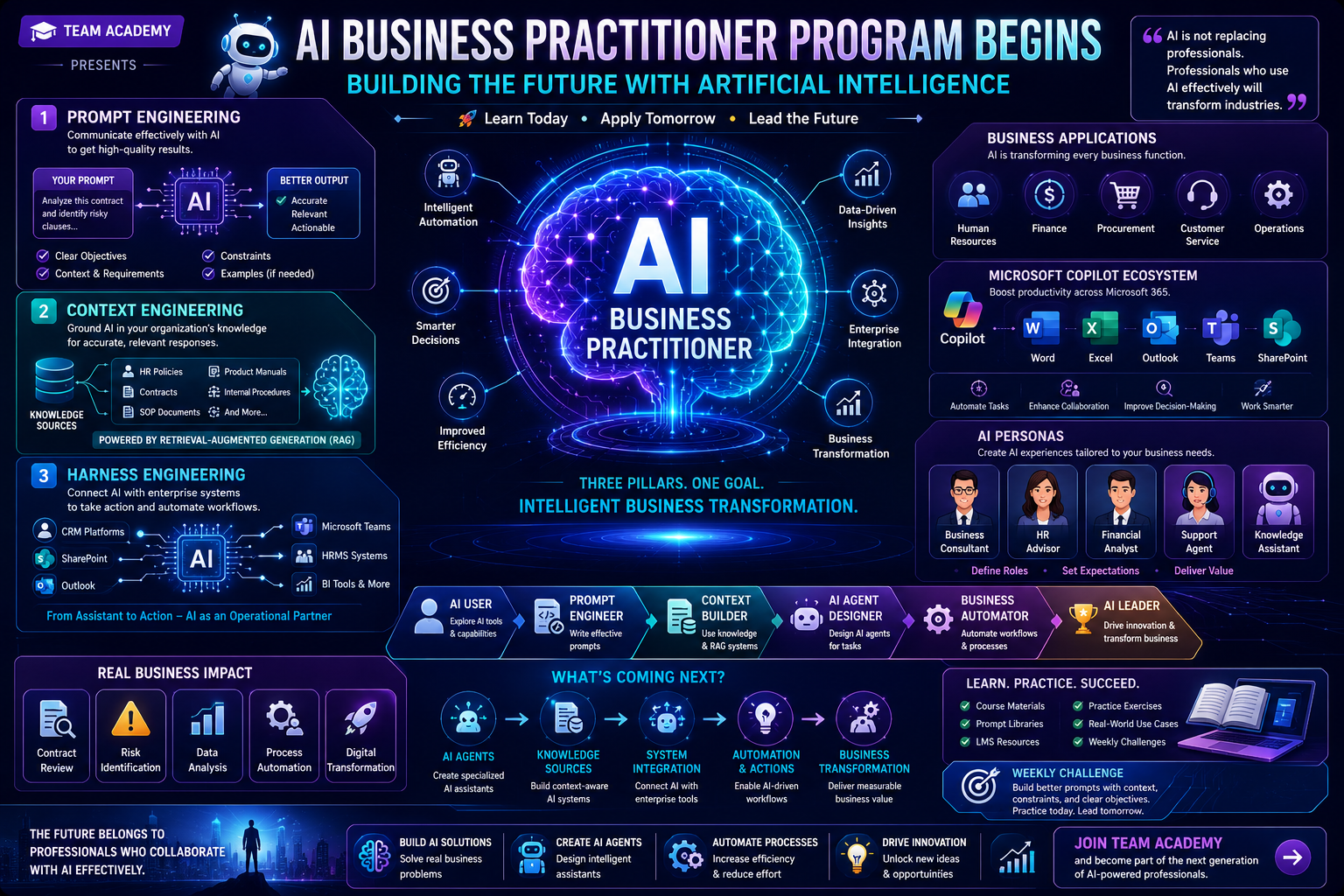
🤖 AI Business Practitioner Program: Foundations of AI, Prompt Engineering & Enterprise AI Solutions
Artificial Intelligence is rapidly changing how organizations operate, innovate, and create value.
In the first session of Team Academy's AI Business Practitioner Program, participants embarked on a journey to understand the foundations of AI implementation, enterprise applications, and the future of AI-driven business transformation.
The session introduced learners to three key domains of AI implementation: Prompt Engineering, Context Engineering, and Harness Engineering.
🚀 The New Era of AI Professionals
The workplace is evolving rapidly.
Organizations today are not only looking for employees who can use AI tools—they are seeking professionals who can design, implement, and manage AI solutions.
The session emphasized a key message:
AI is not replacing professionals. Professionals who use AI effectively will transform industries.
Participants explored how AI is becoming an essential business capability across functions such as:
-
Human Resources
-
Procurement
-
Legal Services
-
Finance
-
Customer Service
-
Operations
🧠 Understanding the Three Domains of AI Implementation
✍️ Prompt Engineering
The first domain introduced was Prompt Engineering.
Prompt engineering is the skill of communicating effectively with AI systems to generate high-quality outputs.
Participants learned that effective prompts should include:
✅ Clear objectives
✅ Relevant context
✅ Constraints and requirements
✅ Examples where needed
The session highlighted that AI performs best when users provide detailed instructions rather than generic questions.
🎯 Best Practices for Prompting
Participants explored practical techniques for creating more effective prompts that generate accurate and useful results.
Key best practices included:
✅ Clearly defining the task or objective
✅ Providing sufficient business context
✅ Specifying the desired output format
✅ Including constraints and requirements
✅ Using examples to guide responses
✅ Refining prompts through iteration
A practical demonstration showed how a simple question can produce vastly different results when enhanced with location, objectives, constraints, and business context.
The session reinforced that well-structured prompts significantly improve the quality, consistency, and relevance of AI-generated outputs.
📚 Context Engineering
The next domain of AI maturity is Context Engineering.
This involves tailoring AI systems to retrieve information from specific organizational knowledge sources.
Examples include:
-
HR policies
-
Contracts
-
SOP documents
-
Product manuals
-
Internal procedures
-
Knowledge repositories
By grounding AI in company-specific information, organizations can create specialized assistants that provide accurate and relevant responses.
This approach is commonly known as Retrieval-Augmented Generation (RAG).
🔗 Harness Engineering
The most advanced domain discussed was Harness Engineering.
At this level, AI agents connect with enterprise systems to perform actions and automate workflows.
Potential integrations include:
-
CRM platforms
-
HRMS systems
-
SharePoint
-
Outlook
-
Microsoft Teams
-
Power BI dashboards
-
Business intelligence tools
Harness Engineering transforms AI from a conversational assistant into an operational business partner capable of supporting real business processes.
💼 AI in Action: Real Business Impact
One of the most compelling discussions centered around a real-world AI implementation case involving contract review and legal document analysis.
Participants explored how AI can assist legal and business teams by:
-
Analyzing agreements
-
Identifying risky clauses
-
Generating commentary
-
Supporting review processes
-
Improving consistency and efficiency
The case demonstrated how AI can reduce repetitive work, improve operational efficiency, and create measurable business value.
The broader lesson was clear:
AI delivers the greatest value when applied to well-defined business processes.
🌱 Developing an Entrepreneurial AI Mindset
The session encouraged learners to think beyond technology and focus on business outcomes.
Key concepts included:
Value Proposition
How does AI solve a business problem?
Innovation
How can AI improve existing processes?
Entrepreneurship
What new opportunities can AI create?
Participants were encouraged to identify business challenges that can be addressed through AI-enabled solutions rather than focusing solely on technology.
🤖 Exploring Modern AI Platforms
Participants explored several leading AI platforms used by professionals and organizations worldwide, including ChatGPT, Claude, and Microsoft Copilot.
The discussion highlighted that different AI models excel in different scenarios depending on business requirements, analytical complexity, integration needs, and security considerations.
Key factors influencing platform selection include:
-
Knowledge retrieval capabilities
-
Enterprise integration options
-
Security and compliance requirements
-
Analytical and reasoning strengths
-
Productivity and collaboration features
The session emphasized that success depends not only on the AI platform chosen but also on how effectively it is configured and applied to business problems.
🤖 Exploring Microsoft Copilot
The session introduced Microsoft Copilot and its role in workplace productivity.
Participants explored how Copilot integrates with:
-
Excel
-
Word
-
Outlook
-
Teams
-
SharePoint
-
OneDrive
These integrations allow professionals to automate repetitive tasks, improve collaboration, and enhance decision-making.
The discussion also highlighted differences between personal AI tools and enterprise AI environments.
Particular emphasis was placed on enterprise security, governance, and data protection. Participants learned why organizations increasingly prefer enterprise-grade AI solutions that provide compliance controls, secure access to organizational knowledge, and protection of business data.
📓 Understanding Microsoft Copilot Notebooks
Participants were introduced to Microsoft Copilot Notebooks and their role in organizing information for AI-assisted work.
Copilot Notebooks allow users to bring together multiple sources of information, including:
📄 Documents
📝 Notes
📊 Reports
🔗 References
📂 Project materials
By keeping related content within a single workspace, Copilot can better understand context and generate more relevant responses, summaries, and insights.
Benefits of Copilot Notebooks include:
✅ Improved knowledge organization
✅ Better contextual understanding
✅ Faster research and analysis
✅ More consistent AI outputs
✅ Enhanced collaboration across projects
Participants learned how notebooks can serve as a centralized knowledge hub for business initiatives, research projects, and operational workflows.
📝 Prompt Engineering in Practice
A practical exercise demonstrated how better prompts lead to better results.
Participants learned that instead of asking broad questions, effective prompts should include:
📍 Location
📍 Constraints
📍 Objectives
📍 Business context
📍 Desired outcomes
This structured approach significantly improves AI accuracy and usefulness.
The session reinforced that prompt engineering is quickly becoming one of the most valuable professional skills in the age of AI.
👤 Personalization, Personas & Custom Instructions
Learners were introduced to the concept of AI personas and custom instructions.
AI personas can be designed to function as:
-
Business Consultants
-
HR Advisors
-
Financial Analysts
-
Customer Support Agents
-
Knowledge Assistants
By defining roles and expectations, users can create AI experiences tailored to specific business needs.
Participants also learned how to configure personas by defining:
✅ Role and expertise
✅ Responsibilities
✅ Communication style
✅ Objectives
✅ Boundaries and limitations
In addition, learners explored custom instructions that help AI understand user preferences, communication styles, objectives, and expected outcomes. These configurations improve consistency, personalization, and relevance across AI interactions.
Well-designed personas help generate responses that are more accurate, relevant, and aligned with specific business requirements.
📚 Learning Through Practical Application
The program emphasizes hands-on learning rather than theory alone.
Participants gained access to:
✅ Course materials
✅ Prompt libraries
✅ LMS resources
✅ Practice exercises
✅ AI use cases
The goal is to help learners apply AI concepts directly to real workplace scenarios.
🎯 Weekly Challenge: Build Better Prompts
To reinforce learning, participants received a practical assignment to create a detailed business prompt that clearly defines:
-
The task
-
Business context
-
Objectives
-
Constraints
-
Expected outcomes
The exercise is designed to strengthen prompt engineering skills and prepare learners for future AI agent development activities.
Participants were encouraged to think like AI practitioners and solution designers rather than simply AI users.
🔮 What’s Coming Next?
Future sessions will dive deeper into:
🤖 AI Agents
Creating specialized assistants for business processes.
📚 Knowledge Sources
Building context-aware AI systems using organizational information.
🔗 System Integration
Connecting AI with enterprise platforms and business applications.
⚙️ Automation
Enabling AI-driven workflows, actions, and intelligent business processes.
Participants will continue progressing from AI consumers to AI solution builders.
🚀 Why AI Skills Matter
Organizations worldwide are investing heavily in AI adoption and business automation.
Professionals who understand:
📌 Prompt Engineering
📌 Context Engineering
📌 AI Agents
📌 Business Automation
📌 Microsoft Copilot
📌 Enterprise AI
📌 Digital Transformation
will be well-positioned to lead future workplace innovation.
The future belongs to professionals who know how to collaborate with AI, design AI-enabled solutions, and apply AI responsibly within business environments.
🎯 Start Your AI Journey with Team Academy
At Team Academy, we focus on practical AI education designed for real business applications.
Learn How To:
✅ Build AI Solutions
✅ Master Prompt Engineering
✅ Design AI Agents
✅ Leverage Enterprise AI Platforms
✅ Automate Business Processes
✅ Drive Digital Transformation
The AI revolution has already begun—and now is the time to build the skills that will shape tomorrow's workplace.
📩 Join Team Academy and become part of the next generation of AI-powered professionals.


