


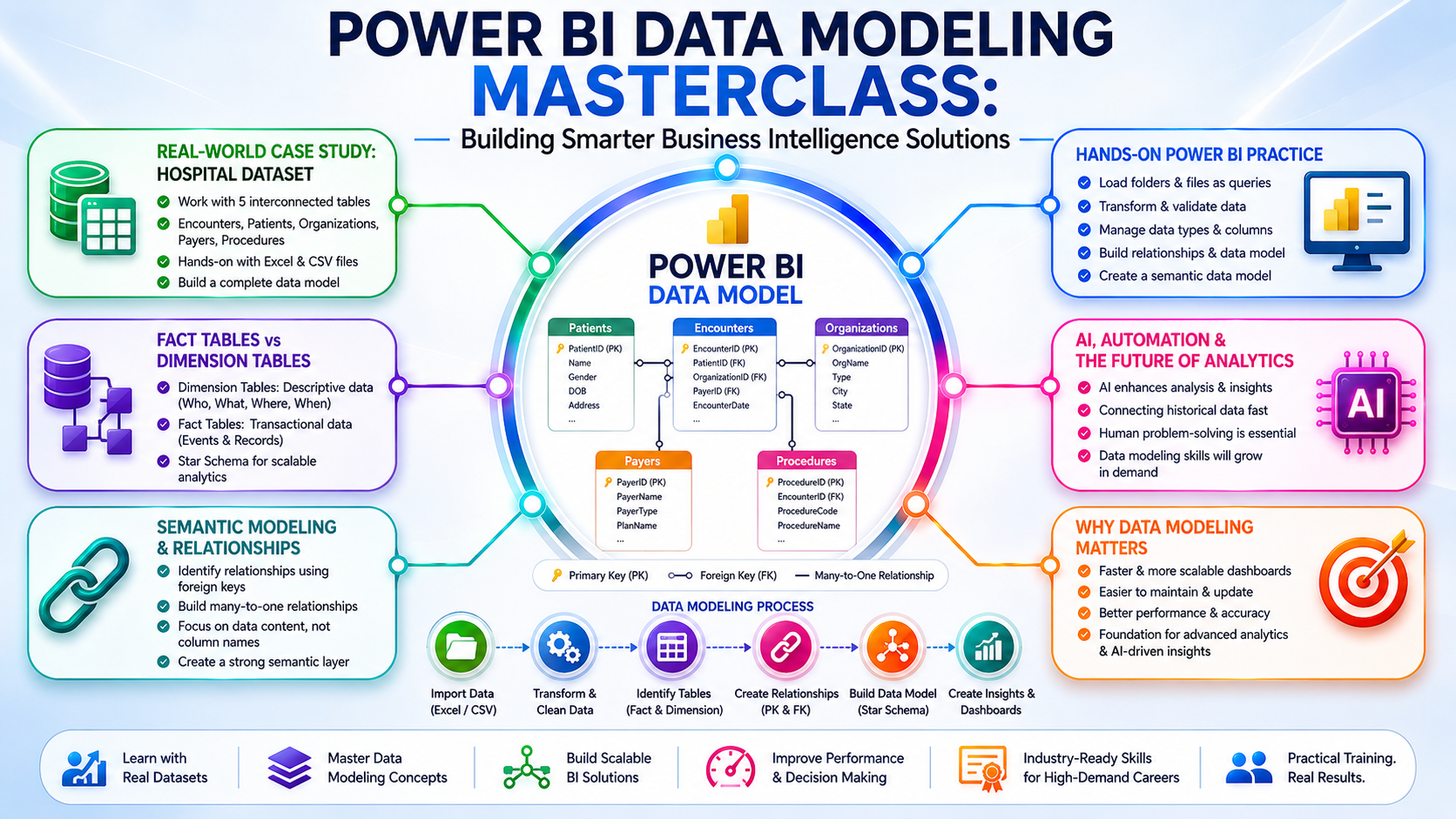
Team Academy learners recently participated in an engaging Power BI Data Modeling session focused on transforming raw datasets into powerful business intelligence models using real-world healthcare data.
The session emphasized practical data modeling techniques, relationship building, semantic understanding, and the growing role of AI in analytics careers.
🏥 Real-World Case Study: Hospital Patient Records
To provide hands-on experience, students worked with a hospital dataset containing five interconnected tables:
-
Encounters
-
Patients
-
Organizations
-
Payers
-
Procedures
Using these datasets, learners practiced:
✅ Connecting multiple Excel and CSV files
✅ Creating data models in Power BI
✅ Identifying fact and dimension tables
✅ Building many-to-one relationships
✅ Using foreign keys correctly
💡 One of the most important lessons:
In data modeling, the content of the data matters more than the column names.
This helped students understand how semantic relationships work in real business environments.
🔗 Understanding Fact Tables vs Dimension Tables
The class explored one of the core concepts of Power BI modeling:
📌 Dimension Tables
Contain descriptive attributes such as:
-
Patient Name
-
Address
-
Demographics
-
Product Information
-
Customer Details
📌 Fact Tables
Contain transactional or event-based records such as:
-
Procedures
-
Encounters
-
Sales Transactions
-
Financial Records
Participants learned how these tables work together through:
-
Many-to-One Relationships
-
Foreign Key Connections
-
Star Schema Concepts
This foundational understanding enables students to create scalable dashboards and perform advanced analytics without relying heavily on formulas like VLOOKUP.
🤖 AI, Automation & the Future of Analytics
A major discussion point during the session was the impact of AI on modern professions.
The team explored how AI:
-
Enhances decision-making
-
Accelerates analysis
-
Connects historical data quickly
-
Improves business insights
At the same time, students learned that:
⚡ Human problem-solving remains essential
⚡ Data modeling skills will become increasingly valuable
⚡ Entrepreneurship and adaptability are critical future skills
The session also highlighted that while AI adoption is still evolving across organizations, demand for skilled data professionals is expected to grow significantly over the next decade.
📂 Hands-On Power BI Practice
Participants also learned practical Power BI techniques including:
-
Loading folders as queries
-
Managing CSV files efficiently
-
Transforming data types
-
Validating datasets
-
Selecting relevant columns
-
Building semantic relationships
Students worked independently on modeling tasks before presenting their completed solutions, helping strengthen both technical and analytical thinking.
🚀 Why Data Modeling Matters
Strong data modeling is the foundation of every successful Power BI dashboard.
Professionals who understand:
✔ Relationships
✔ Fact & Dimension Tables
✔ Star Schema Design
✔ Semantic Modeling
✔ Data Transformation
can build dashboards that are:
-
Faster
-
More scalable
-
Easier to maintain
-
More business-friendly
These are essential skills for anyone pursuing careers in:
-
Data Analytics
-
Business Intelligence
-
Financial Reporting
-
Healthcare Analytics
-
AI-Powered Decision Making
🎯 Ready to Master Power BI?
At Team Academy, we combine:
✅ Practical training
✅ Real business case studies
✅ AI-powered analytics insights
✅ Industry-focused learning
✅ Hands-on Power BI projects
👉 Join Our Upcoming Power BI Programs
Learn how to:
-
Build professional dashboards
-
Master data modeling
-
Create scalable BI solutions
-
Work with real datasets
-
Prepare for high-demand analytics careers
📩 Contact Team Academy today and take the next step toward becoming a Power BI expert!


